
What would Christmas have been like aboard the Packet Ships?
Walsingham served as a Packet from 1794 – 1825, straddling the reigns of George III and George IV, formerly the Prince Regent. Christmas at the time was quite a different affair to the celebration we have now. Today, Christmas has arguably become the most widely celebrated Christian festival of them all, and has become a cultural as well as religious phenomenon. In the time of Walsingham, however, Christmas was just one of many feast days and holy days in the calendar, and while Christmas was less important than it is now, the other feast days – especially Easter – were much more widely celebrated and given greater status. So what would Christmas have been like aboard the Packet Ships?
From the recorded movements of Walsingham, we know she was at sea for Christmas 1822, sailing from New York to Falmouth commanded by Captain John Bullock. Bullock grew his wealth as a result of the Packet command and built Penmere Manor in Falmouth (the building still exists as a luxury hotel). One of his sons went into the church, so it’s likely that he was a religious man, as was usual in the period. Sea captains at this time usually doubled as ship’s chaplain, except in the Navy where they were more likely to have had a chaplain in the crew. Aboard Walsingham, however, the religious service on Christmas Day was most likely led by Bullock himself.

Christmas would have had a different feel due to the effect of the change from the Julian to the Gregorian calendar in 1752. Just 42 years before Walsingham began serving as a Packet ship, the country had ‘lost’ 11 days due to this change, and the legal year had been moved from Lady Day (25th March) to our modern New Year’s Day on the 1st of January. Rather than the small period of Twixmas that we celebrate now – during which time many workplaces are closed altogether – folk in 1751 were celebrating the 12 days of Christmas, going back to work, and then building up to the new year at the end of March. It is no small wonder that the change caused some disruption to the rhythm of the year, although it probably didn’t result in the so-called Calendar Riots, which appear to have been exaggerated by William Hogarth’s tendency not to allow the truth to get in the way of a good painting.
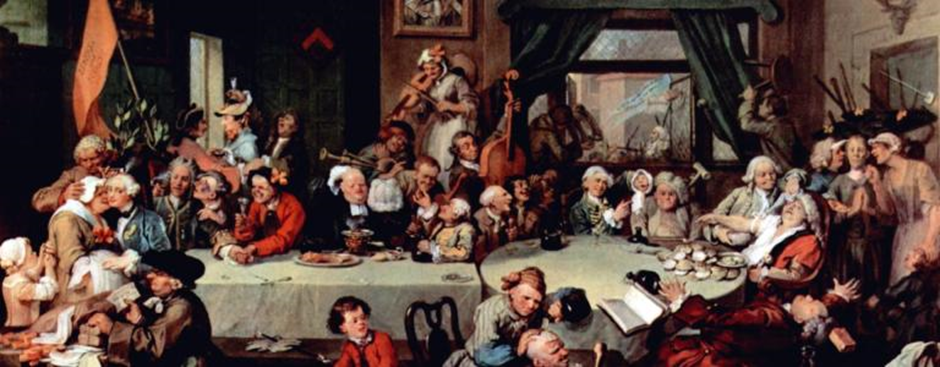
Nevertheless, for the older members of the Packet crews, Christmas was 11 days sooner than it would have been when they were children. This was particularly pertinent in Cornwall, as the Cornish, being extremely independent-minded, hadn’t taken well to the imposition of the calendar change and were still celebrating Old Christmas 11 days later on the 5th of January, a custom which still prevails in some villages alongside the modern celebration of New Christmas. If there were any Cornish crew, there could well have been robust discussion as to the date of celebration of Christmas aboard.
The Packet Service also supported a wealth of ancillary industries in Falmouth, such as sailmakers, block makers, anchor smiths, insurance brokers, clergymen and innkeepers. Christmas for working people at the time was over quickly, but for the part of the day that wasn’t spent in church, the timeless entertainments of eating, drinking and charades were popular. Charades was a game with higher stakes at the time, often involving a character being secretly given at the beginning of a party, with the expectation that players would stay in character until their identity was guessed. For high society, this could involve providing costumes for all the guests, with masks to assist the poker faced maintenance of character. For the poor, it would have been no more than a whispered name in the ear.
Dancing was also popular with rich and poor alike, and the agricultural custom of country dancing in lines and sets had been copied by the rich, so that the Music Room at the Royal Pavilion in Brighton – the Prince Regent’s favourite retreat – would have rung to the tune of a fiddle and the steps of a dance copied from the ploughboys at the farm. In Cornwall, far from the seat of power in London, the crew and workers involved with the Packet Ships had plenty of work to keep them busy – in a time when Christmas was a quick affair, they had ships to sail, sails to sew and miles of open sea to cover to deliver the precious Packets.

This is a really fascinating insight, especially with the reminder of the calendar changes and how this would have impacted annual dates. Nicely written.